
Turning photography into a living is less about gear and more about a series of decisions: how you learn, what you show, how you get paid and who you work for. This guide lays out those decisions so you can choose with open eyes rather than follow a generic tutorial path.
- Professional status comes from how you earn and run a business, not from a certificate.
- Training can be a degree, an apprenticeship, a structured course or self-directed study, and each has real trade-offs.
- Your income depends on understanding licensing, assignment work and the unglamorous admin around both.
What actually makes someone a professional photographer?
The line between amateur and professional is blurrier than most people expect. An amateur shoots for pleasure with no intention of selling images. A professional is paid, whether through a session fee, a salary, or the display, resale or use of the pictures. That payment can come in several forms, so it helps to know which one you are aiming at.
- Freelancer: you work for yourself and sell your services or your images.
- Employee: you shoot on salary, for example for a newspaper.
- Contract work: you cover a planned event such as a wedding or graduation, or illustrate an advertisement.
- Fine art: you make an image first, then license it or sell prints.
There is no compulsory registration to call yourself a professional photographer. Running a business, however, usually means holding a business licence where you live, and many venues expect commercial insurance if you shoot a wedding or public event. Treat these as part of the job from the first paid booking, not something to sort out later.
Many working photographers also specialise. Picking one early makes your portfolio and your marketing far easier to focus.
Which training route should you choose?
There is no single required qualification, and the right route depends on your budget, your timeline and how you learn best. The main options look like this.
Formal education and apprenticeships
In the UK, official careers guidance lists a foundation degree, a higher national diploma or a degree as one entry path, along with a college course that may lead to work as a photographer’s assistant. It also mentions a Photographer Level 4 Higher Apprenticeship, which takes around 1 year and 6 months and mixes workplace training with off-the-job study. If you are outside the UK, look for the equivalent in your own country.
Structured courses and certification
Private programmes exist too. One Canadian provider, Learn Photography Canada, runs a certification built around six in-person fundamentals courses, a six-month online mastery phase and a 30-image portfolio assessed by its instructors. A certificate like this can add structure and feedback, but it is a school’s own accreditation rather than a licence to practise, so weigh the cost against what you would actually gain.
Skipping photo college
Not everyone agrees that a degree is worth it. New York photographer Chris Buck argues that you can learn what you need through books, mentors and short-term courses, and warns against starting your career under heavy college debt. The cost is a harder road with more trial and error, but you keep the freedom to live and work wherever you like.
A sensible way to decide: price each route honestly, then ask which one gives you regular critique from people who hire photographers. Feedback matters more than the label on the course.
How do you build a portfolio that attracts clients?
Your portfolio is the main evidence that you can do the job. Careers guidance for the UK stresses that you need one to show your skills, interests and experience, and that posting examples online helps you get noticed. The harder question is what belongs in it.
Start by showing your work to people who do not already love you. Praise from family and friends feels good but tells you little about whether a commissioning client will respond. An art director who passes on your work is giving you information, even when it stings.
- Show range inside a focus. Technical competence across lighting, exposure and composition is the baseline, and a single lighting setup repeated everywhere will limit you.
- Look for your own angle. Technical craft is easy to copy. What sets your work apart is how you see and approach your subjects.
- Avoid imitation. Copying a famous photographer’s lighting and editing produces a weaker version of someone else’s style.
- Cut ruthlessly. A smaller set of strong, related images reads as a body of work. A large mixed set reads as undecided.
If you are following a certification route, note that one programme asks for a 30-image portfolio, but that figure is that school’s requirement, not an industry standard. There is no magic number that guarantees clients.
How do you get paid: licensing, assignments and the business side?
Understanding how photographers earn money changes how you quote and what you agree to. Two ideas matter most: production fees and usage fees.
A production fee pays for the creation of the photographs. A usage fee pays for the right to use them, and it is set through a licence that controls how often a picture appears, in which territory and on which products. Licences can be exclusive or non-exclusive and may run for a fixed period such as a year. Some contracts add a royalty, and cover images typically command higher fees than pictures used elsewhere in a publication.
Assignment work and ownership
Photos made on assignment are often work for hire, meaning the company or publication owns them unless the contract says otherwise. Portrait and wedding photographers commonly keep the copyright and sell further prints themselves. If a client wants to reproduce the images on their own, you can agree a larger upfront fee in exchange for reprint rights, but settle this before the shoot.
Stock and independent sales
Online stock catalogues let you sell images quickly, but many pay very little, offer no royalty and give you no control over use. Selling images independently can add income, though it should not be your only plan.
The unglamorous part
You will need money for equipment, a place to work, and business, marketing and admin skills. Official careers guidance describes photography as very competitive and notes that freelance work is common. Put every agreement in writing, be clear about what the fee covers, and never quote a price without knowing how the pictures will be used. That single habit is the best protection against underselling yourself.
Research current rates in your own market before setting prices.
Frequently asked questions
Do you need a degree to become a professional photographer?
No. There is no compulsory registration or required qualification. Some people choose a degree, college course or apprenticeship, while others learn through books, mentors and short courses. What matters most to clients is the work you can show them.
Is working as a photographer’s assistant a good first step?
It can be, since many people start as an assistant and work their way up. One working photographer warns that assisting can pay well but may delay building your own creative foundation. Consider a limited stretch of assisting or interning, then move toward your own projects.
What is the difference between a usage fee and a production fee?
A production fee pays for creating the photographs, while a usage fee pays for the licence to use them. The usage fee depends on how often, where and for which products the images will appear. Agree both in a written contract.
Who owns the photos you take on assignment?
Often the client does, because assignment work is frequently treated as work for hire unless the contract states otherwise. Portrait and wedding photographers commonly keep copyright by contract. Always settle ownership and reprint rights before you shoot.
Related reading
- Street Photography: Etiquette, Nerves and the Law in General Terms
- Planning a Landscape Shoot: Maps, Tides, Sun Position and Patience
Sources
- Professional Photography Certification Program | LPC (learnphotographycanada.com, accessed 2026-11-04)
- Photographer | Explore careers (nationalcareers.service.gov.uk, accessed 2026-11-04)
- 5 Tips To Be A Photographer — Chris Buck (chrisbuck.com, accessed 2026-11-04)
- Photographer — Wikipédia (en.wikipedia.org, accessed 2026-11-04)
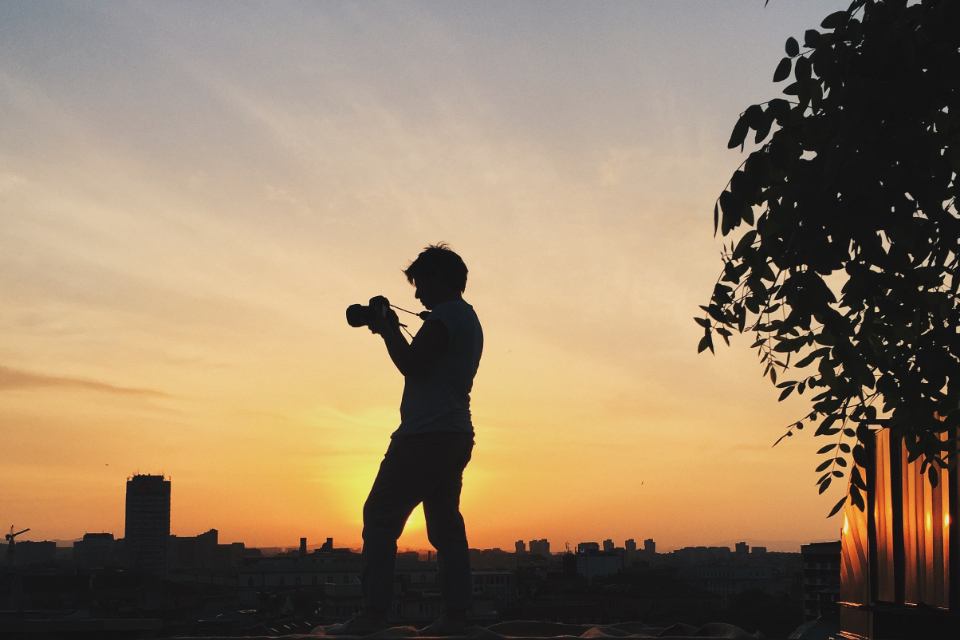
Photo: Person Photographer, by donterase, CC0 1.0 (Stocksnap, via Openverse)