
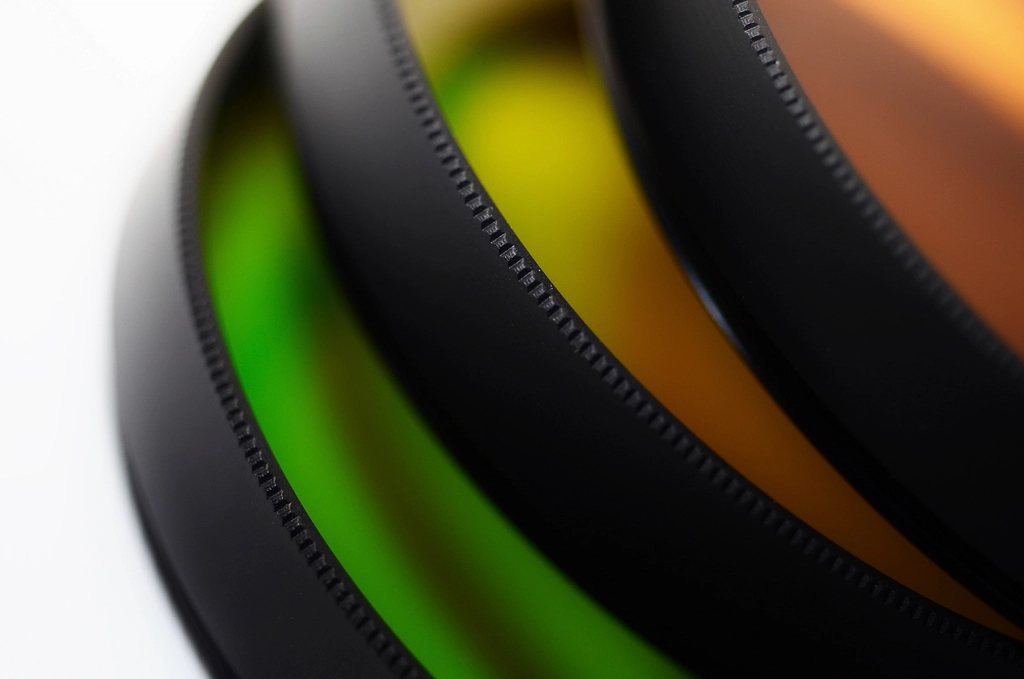
Editing software has swallowed most of the filter drawer. Warming filters, colour correction gels, soft-focus glass and the whole family of creative effects are now sliders, and we do not miss carrying them. But three kinds of filter do something to the light before it reaches the sensor that no software can undo or reproduce afterwards. Those three, the polariser, the neutral density and the graduated neutral density, still belong in the bag. Here is what each one does, when we reach for it, and what it costs in money and in light.
Why some filters survived the digital age
Software works on the data the sensor recorded. If the reflection on the water hid the rocks beneath it, the rocks are not in the file and no amount of dehaze will bring them back. If the highlights in the sky clipped to white, they are gone. If the waterfall was frozen at 1/250 of a second, no plug-in will turn it into silk. A filter changes what gets recorded in the first place, and that is the whole argument for keeping the three that matter.
The circular polariser
A polariser cuts light that is vibrating in one plane, which in practice means reflections from non-metallic surfaces: water, glass, wet leaves, painted cars, haze in the sky. Rotate the front ring while looking through the viewfinder and you watch the reflection fade and the colours underneath deepen. Skies go a richer blue at 90 degrees to the sun and stay unchanged when the sun is behind or in front of you. Foliage loses its shine and shows its actual green.
The cost is 1.5 to 2 stops of light, so a scene that was 1/500 at f/8 becomes 1/125 to 1/160. On wide lenses below about 24 mm on full frame, the effect is uneven across the sky, leaving a dark band that looks odd; we use it with care on ultra-wides or not at all. A good circular polariser in a slim mount to avoid vignetting costs USD 60 to 150 for a 77 mm size, and it is the one filter we would buy before any other. Buy it in the largest thread size you own and use step-up rings for the smaller lenses. Remember to take it off in low light and when shooting through a window at an angle, where it costs light and does nothing useful.
Neutral density: trading light for time
A neutral density filter is a grey piece of glass that reduces light without changing colour, at least in theory. It exists to let us use a slower shutter speed or wider aperture than the light would otherwise allow. Strengths are quoted in stops: a 3-stop ND turns 1/60 into 1/8, a 6-stop ND turns 1/60 into one second, and a 10-stop ND turns 1/60 into about 15 seconds. That last one is the classic tool for milky water, streaked clouds and empty streets where the walking crowd blurs into nothing.
For video, a 3 to 6 stop ND is not optional in daylight. To keep the shutter at 1/50 for a natural 25 frames per second look at f/2.8, bright sun demands roughly 5 stops of reduction. Variable ND filters, two polarising layers that rotate against each other, cover 2 to 8 stops in one filter and cost USD 100 to 300. They are convenient, but at the strong end they produce a dark cross pattern on wide lenses and often carry a colour cast. Fixed NDs at USD 50 to 150 each are cleaner; we carry a 6 and a 10, and stack them for 16 stops when the midday light demands it.
Two practical notes. First, with a 10-stop filter, the viewfinder goes almost black, so compose and focus first, then fit the filter and switch to manual focus. Second, check the colour: cheaper strong NDs add a magenta or warm cast that is fixable in raw but annoying in video, and the price difference between the budget and mid-range glass buys mostly better neutrality.
Graduated ND: the one that software half-replaced
A graduated ND is dark on top and clear on the bottom, with a soft or hard transition between them. It was invented to hold back a bright sky so the land below could be exposed properly on film. Modern sensors capture 13 to 15 stops of dynamic range, and raw software has a graduated adjustment that does the same job with no glass, so for many landscapes the physical filter is no longer needed.
It still earns its place in two cases. When the sky is so bright that it would clip in a single exposure, and we cannot or do not want to blend brackets, a 2 or 3 stop hard-edged grad over a flat horizon saves the highlights in one frame. And in video, where bracketing is impossible, it remains the only way to balance a bright sky against a darker foreground. Rectangular grads in a holder system, 100 mm wide, cost USD 80 to 200 each plus USD 50 to 150 for the holder. They do not work well over jagged skylines, where the transition darkens whatever crosses it.
What we carry and what we skip
- Circular polariser, 77 or 82 mm, with step-up rings: always in the bag.
- Fixed 6-stop and 10-stop ND: for water, clouds, crowds and daylight video.
- One 3-stop soft grad and holder: only on trips where big flat horizons are likely.
- UV or protection filters: we skip them on lenses with a hood, which protects better and adds no extra glass surface.
Buying and caring for filters
Coatings matter more than the brand name. A multi-coated filter with a water-repellent front layer flares less, cleans faster and shows fewer ghosts when the sun is in the frame. Slim mounts avoid vignetting on wide lenses but usually lose the front thread, so the lens cap will not fit over them. Store filters in a hard case, never loose in a pocket with keys, and clean them like a front element: blower first, then a microfibre cloth and a drop of lens fluid only if needed. A scratched filter is worse than no filter, because every image passes through it. Treated well, a good polariser and a pair of NDs will outlast several camera bodies and never need a firmware update.