
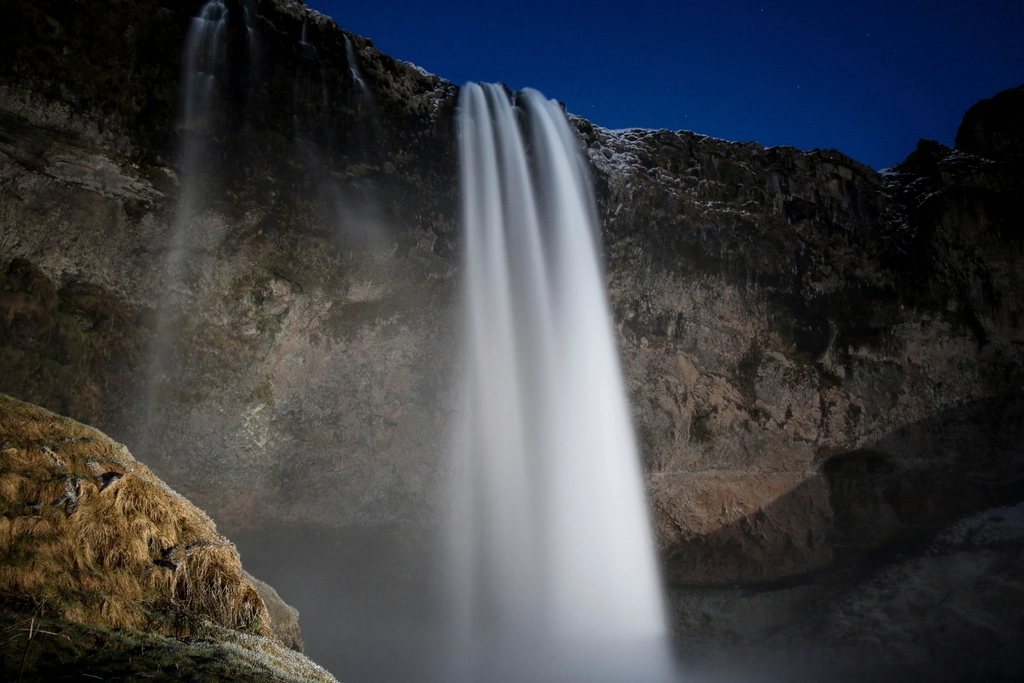
Long exposure is the one technique where the camera records something the eye cannot see: time. Waves flatten into mist, clouds streak across a sky, headlights become ribbons of light. It is also the technique that punishes sloppiness most. A tripod leg that creeps, a strap that catches the wind, a filter that leaks light at the edge, and the frame is wasted after a two-minute wait. Here is how we set up, expose and finish long-exposure photographs so that the waiting pays off.
What counts as long, and what it does
Anything slower than about 1/4 s is beyond hand-holding and starts to change how motion looks. The effects arrive in stages. At 1/2 s to 2 s, moving water softens but keeps texture; the streams between rocks become smooth threads. At 5 s to 30 s the sea turns to fog, and people walking through a plaza become faint ghosts or vanish entirely if they keep moving. At 1 to 4 minutes clouds stretch into long brushstrokes and a busy harbour looks deserted. Traffic trails need only 10 to 30 s in a city at night, long enough for several cars to cross the frame.
We usually decide on the effect first and work backwards to the shutter speed, because the look of the water or the sky is the point of the picture, and the rest of the exposure has to fit around it.
ND filters: buying time in stops
In daylight you cannot get to 30 s by stopping down. A bright coastal scene meters at f/11, 1/250 s, ISO 100. Closing to f/22 only buys two stops (1/60 s), and diffraction is already softening the frame. The rest has to come from a neutral density filter, which is simply dark glass rated in stops.
- 3-stop ND: 1/250 s becomes 1/30 s. Useful for panning and slight water softening.
- 6-stop ND: 1/250 s becomes 1/4 s. The workhorse for waterfalls and streams.
- 10-stop ND: 1/250 s becomes 4 s. Sea fog and moving clouds in daylight.
- 15-stop ND: 1/250 s becomes 2 minutes. Empty streets at noon, dramatic skies.
Stacking a 6 and a 10 gives 16 stops, but every extra glass surface adds flare and a slight colour cast, usually warm on cheap filters and slightly cool on better ones. Shoot RAW and set a custom white balance once in editing; the cast is uniform and comes out in a click. Also compose and focus before the filter goes on, because through a 10-stop glass the viewfinder is nearly black and autofocus will fail. Focus, switch the lens to manual, then thread the filter on gently without rotating the focus ring.
Bulb mode and how to count
Most cameras stop at 30 s on the dial. Beyond that you use bulb, where the shutter stays open as long as the release is pressed. Use a cable or wireless release, or the camera’s own timer if it offers timed bulb, because a thumb on the body for two minutes guarantees vibration. The arithmetic is simple: take the unfiltered metered speed, then double it once per stop of ND. From 1/15 s with a 10-stop filter: 1/15 doubled ten times is roughly 68 s, so set 60 to 70 s. From 1/8 s with a 15-stop filter: 4096 s, about 68 minutes, which is why nobody uses a 15-stop at 1/8 s.
We work with ISO 100 or the base ISO of the sensor and f/8 to f/11 as a starting point. If the calculated time is too long to be practical, open one stop rather than raising ISO; if it is too short for the effect, close one stop or add a filter. Always bracket the first frame by a stop either way and read the histogram, not the preview, because the rear screen at night lies about brightness.
Tripod discipline
The tripod is where long exposures live or die. Spread the legs fully and use the thickest sections first; the thin lower sections and the centre column are the last things to extend, not the first. Hang a bag from the hook only if the wind is calm, otherwise the bag swings and acts as a pendulum. Remove the strap or wrap it around a leg. Switch stabilisation off on a tripod, because some systems drift while trying to correct a movement that is not happening.
Cover the viewfinder. On a two-minute exposure, light entering the eyepiece can fog the frame or shift the meter reading; a strip of tape or the little cap that came with the camera does the job. Use a 2 s self-timer or a release even for 1 s exposures. Mirror shock is a problem only on older bodies, but shutter shock is real on any camera; electronic first curtain or a fully electronic shutter removes it. On soft ground, push the feet in and wait thirty seconds for the legs to settle before the first frame. On a pier or a bridge, time the exposure between footsteps and passing trucks if you can.
Noise in long exposures
Long exposures make a different kind of noise from high ISO. Over tens of seconds the sensor warms and some pixels stay lit: hot pixels, bright single dots scattered across shadows. The camera’s long exposure noise reduction fixes this by taking a second, black frame of the same length and subtracting it. That doubles your time at the tripod, so for a 4-minute exposure you wait 8 minutes. We turn it on for anything over 30 s in warm weather, and off in winter, when a cold sensor barely produces hot pixels.
Keep ISO at base. Shadow noise from underexposure is far worse than the fine grain of ISO 200, so if the histogram is bunched to the left, add time rather than lifting shadows later. And watch the battery: a long exposure at minus 5 C on a cold night can drain a full pack in an hour, and a camera that dies at 90 s into a 120 s frame writes nothing.
Three set-ups that always work
Waterfall, overcast day: 6-stop ND, f/11, ISO 100, 2 s. The falling water blurs to threads while the wet rocks stay sharp. Coastline at sunset: 10-stop ND, f/8, ISO 100, 60 s, started ten minutes before the sun touches the horizon. The sea turns to a flat sheet and the clouds pull towards the light. City traffic, blue hour: no filter, f/11, ISO 100, 20 s, with a road curving into the frame so the trails lead somewhere.
Long exposure asks for patience more than gear. A steady tripod, a dark filter, a release, and a willingness to stand still for a few minutes while the world moves around the frame. What you bring home is a picture of time itself.