
Before we raise a camera, we look at the ground. Not at the subject, not at the sky, but at the shadow of the nearest lamp post, tree or person. The edge of that shadow tells us almost everything we need to know about the light we are about to work with. If the edge is crisp, we are in hard light. If it is a soft gradient that fades into the pavement, the light is soft. If there is no shadow at all, the light is very soft indeed. This one habit, checked in two seconds, decides how we will shoot for the next hour.
Where hardness comes from
The hardness of light is not about brightness. A dim bare bulb in a dark room makes shadows as sharp as the noon sun. Hardness comes from the apparent size of the light source relative to the subject. A small source, or a large one far away, throws light from a single direction, so every point on the subject is either lit or not lit, with a sharp line between. A large source close to the subject wraps light around from many directions at once, so the transition from lit to unlit is spread out and the shadow edge blurs.
The sun is enormous, but it is so distant that it behaves as a point. Hence the hard shadows of a clear day. Put a layer of cloud between the sun and the ground and the entire sky becomes the source. Now the light arrives from everywhere at once and shadows nearly vanish. The same physics applies indoors. A window is soft when the subject stands beside it and much harder when the subject is across the room. A wall that bounces light back becomes a second, softer source. The size and distance rule explains all of it.
What hard light gives you
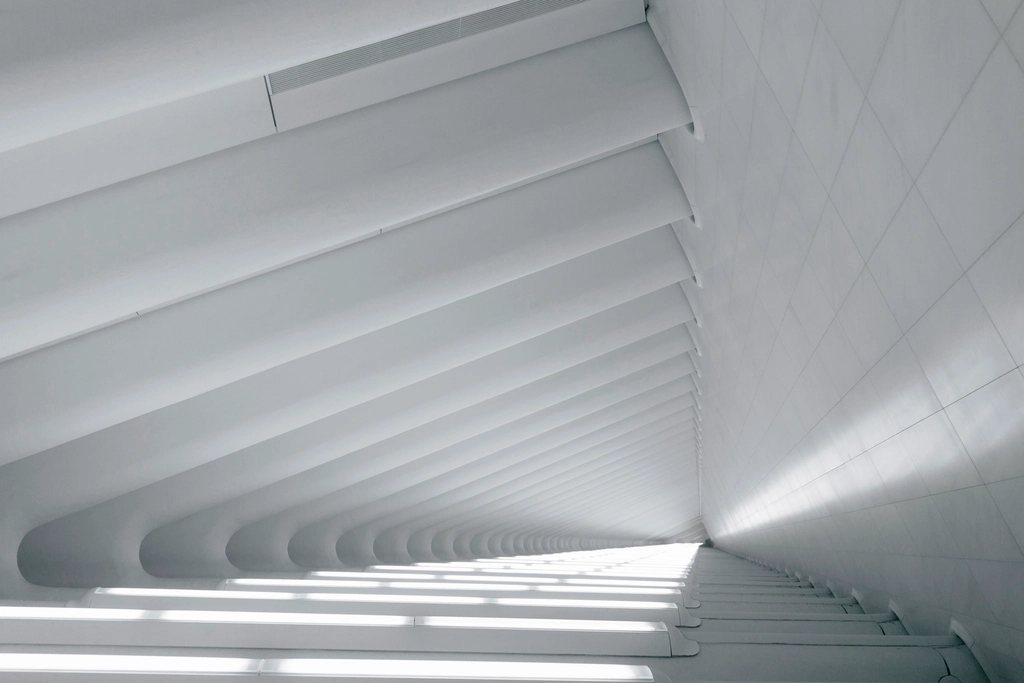
Hard light has a poor reputation because it is unforgiving on faces. Every pore, line and blemish gets its own tiny shadow. But that same quality is a gift for anything with texture or structure. Architecture becomes graphic, with clean edges and blocks of black. Sand, rock and rusted metal show their surface. Shadows become subjects: the pattern of a railing on a wall, the elongated shape of a walking figure, the lattice of a fire escape on a shopfront.
Hard light also gives you the strongest colour. Direct sun on a red door is redder than the same door under cloud, because nothing has diluted the light on its way in. And it gives you contrast that reads from across the room. Some of the most memorable street pictures of the last century depend on a slab of sun cutting a dark street into two halves and a single figure stepping into the bright half.
The cost is dynamic range. A face in direct noon sun with a shaded side can span seven or eight stops from the lit cheek to the shadowed eye socket. You will have to choose. Expose for the highlights and let the shadows go black, which turns a portrait into a graphic study. Or expose for the shadows and accept a burnt-out cheek. Or move the subject until the shadow falls somewhere kinder, which is usually the right answer.
What soft light gives you
Soft light forgives. It fills in the hollows of a face, hides skin texture and lets the eyes stay open without squinting. It compresses the range between bright and dark into something a sensor holds easily, so exposure becomes almost trivial. Colours become gentler and more even, which suits portraits, food, flowers and anything where you want the viewer to look at the subject rather than at the light.
The weakness is the mirror of hard light’s strength. Soft light flattens. A landscape under a full grey sky can lose all sense of depth because nothing has a shadow to sit in. Textures disappear. A white wall under overcast becomes a white nothing. Photographers who only shoot on cloudy days sometimes wonder why their work looks polite and a bit dull, and this is why.
Soft is also a spectrum. An overcast sky is soft but still directional: the light is brighter from above than from the sides, which is why people under cloud have shadows under their eyebrows and noses. Open shade on the north side of a building is softer and more even. A subject under a white umbrella, with light bouncing back from a pale floor, is the softest of all and looks almost like a studio.
Reading the shadow before you shoot
The shadow edge is your meter. We check three things in order, and the whole check takes a few seconds.
- Edge: sharp, feathered, or absent. This tells you the size of the source.
- Direction: where the shadow points tells you where the light comes from, and whether it is front, side, back or top light.
- Density: how dark the shadow is compared to the lit area tells you the contrast and whether nearby surfaces are bouncing light into it.
Density is the one people skip. Two hard-light scenes with identical edges can behave completely differently. On a beach, the sand throws so much light upward that the shadows on a face are open and bright. In a narrow street of dark stone, the same sun leaves shadows that are almost black. Look at the ground and walls around your subject, because they are the second light source in every scene.
Changing the light without changing the weather
You rarely get to choose the light, but you can always choose where you stand and where your subject stands, and that changes the light more than any setting on the camera. Under hard sun, walk your subject into the shadow of a building. The sun is gone and the open sky remains, so you have converted hard light into soft in a few steps. Turn them so the bright open sky is in front of their face rather than behind, and the eyes light up.
Under soft overcast, do the reverse. Find something dark to place behind the subject, so that even a flat light creates separation. Look for the edge of a canopy or doorway, where the light comes from one side only and starts to shape the face again. Shoot low, so that the brighter sky is not competing with the subject. Or wait: cloud thins and thickens constantly, and a moment of thin cloud gives a half-hard light that many portrait photographers consider the best of both worlds.
Hard and soft are not good and bad. They are two different tools, and the shadow edge on the ground tells you which one you have been handed today. Read it before you shoot, and you will spend far less time fighting the light and far more time using it.