
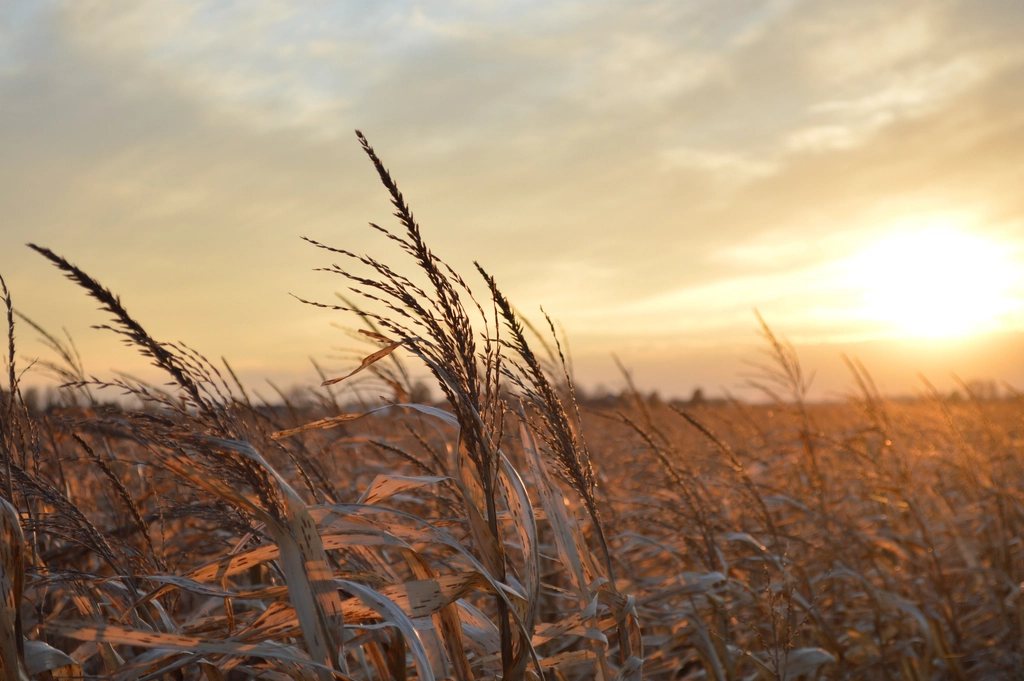
Ask a room full of photographers when the best light happens and most will say the same thing: golden hour. It is not a wrong answer, but it is an incomplete one. We have spent years chasing light at the edges of the day, and the longer we do it, the more we notice that the famous hours are only two of at least four distinct kinds of light around sunrise and sunset. One of them, just before the sun rises and just after it sets, is almost never talked about. We use it more than any other, and this article is partly an argument for it.
What golden hour actually does to a scene
Golden hour is the stretch when the sun sits low, roughly within ten degrees of the horizon. Its light travels through far more atmosphere than it does at noon, and that thicker slice of air scatters the blue wavelengths away. What arrives at your subject is warm, orange to amber, and it comes in almost sideways. The low angle is what matters most for pictures. Sidelight rakes across textures, so plowed fields, brickwork, skin, sand and bark all show their surface. Shadows stretch long across the ground and become shapes in their own right, often more interesting than the objects casting them.
The second gift of golden hour is contrast. Because the sun is weak, the difference between the lit side and the shaded side of a face is manageable. A sensor can hold both without blowing out one or crushing the other. This is why a portrait made at seven on a summer evening looks effortless and the same portrait at one in the afternoon looks like a passport photo under a floodlight. The subject has not changed. The ratio between light and shadow has.
It also passes quickly. In the tropics, golden hour can be twenty minutes. At high latitudes in midsummer it can drag on for two hours. Knowing your latitude and season tells you how much you need to hurry.
Blue hour and why it is quieter than it looks
When the sun drops below the horizon, the warm direct light is gone, but the sky still glows. That glow is the blue hour, and it lasts roughly until the sun is about six degrees below the horizon. The light now comes from the whole dome of the sky rather than from a single point, so it is soft, nearly shadowless, and cool in tone. The word blue undersells it. Depending on the air and the clouds, it can run through violet, steel, teal and a deep indigo in the last minutes.
Blue hour is the hour of the city. Streetlights, shop windows and headlights are warm, the sky is cool, and the two sit against each other with a natural complementary contrast that no filter can fake. The trick is timing. Too early and the sky overpowers the artificial lights. Too late and the sky goes black and you lose the shape of buildings against it. There is usually a window of ten to fifteen minutes when the exposure for the sky and the exposure for the lights are close enough to fit in one frame. We set up early and keep shooting through it, because the moment is easy to miss and impossible to recover.
For landscapes, blue hour rewards water, snow and anything pale that can pick up the colour of the sky. It punishes dense forest and dark subjects, which just go to mud. It is also a tripod hour. Exposures run into whole seconds: moving water smooths, traffic becomes ribbons, and people walking through the frame fade to ghosts.
The hour nobody uses
Between blue hour and golden hour there is a short overlap that most people spend walking to the car. Before sunrise, the sky has enough light to show colour but the sun has not yet touched the land. After sunset, it is the reverse: the sun is gone from the ground but the clouds overhead are still lit from below. We think of this as the pre-light and the afterglow, and it is where many of our favourite pictures were made.
What makes it special is the combination. The ground is lit by the soft, cool sky, so it has the gentle, open shadows of blue hour. Meanwhile the clouds, if there are any, are catching the sun from beyond the horizon and burning pink, coral or orange. You get warm and cool in one frame, each in the place where it looks best, with none of the harsh shadows that arrive the moment the sun clears the hills. The light lasts five to fifteen minutes and changes second by second, which is exactly why people miss it. They arrive for the sunrise and the good part is already over.
Our habit is simple. We are in position and composed forty minutes before sunrise, and we stay forty minutes after sunset. The sun itself is usually the least interesting thing that happens.
Reading the sky the day before
None of these hours perform on a clear sky. Clear skies give you a clean golden hour, a rather flat blue hour, and almost no afterglow. What you want is broken cloud, ideally high or mid-level, covering between a third and two thirds of the sky, with a clear gap on the horizon where the sun will rise or set. That gap is essential. If cloud sits on the horizon, the sun is blocked at the exact moment it would light the clouds from beneath, and the show is cancelled.
Forecasts that show cloud cover by altitude are more useful than a general percentage. A quick look at the sky in the hour before the event tells you more than any app: a rim of clear sky low in the west at sunset is the sign we most want to see.
A working plan for the edges of the day
Rather than picking one hour and hoping, we plan the whole sequence.
- Forty minutes before sunrise: arrive, compose in the dark, tripod up, expect the afterglow in reverse.
- Twenty minutes before: the pre-light. Watch the clouds, shoot the warm sky over cool ground.
- Sunrise to about an hour after: golden hour. Move around, work sidelight and long shadows, hand-held is fine.
- Reverse the sequence in the evening, and stay through the blue hour until the sky is truly dark.
The point is not to prefer one light over another. It is to know that four kinds of light pass through the same place in a little over an hour, and that each asks for a different subject and a different way of working. Golden hour is generous and easy. Blue hour is calm and cool. The narrow hour between them is the one that keeps us getting up in the dark.