
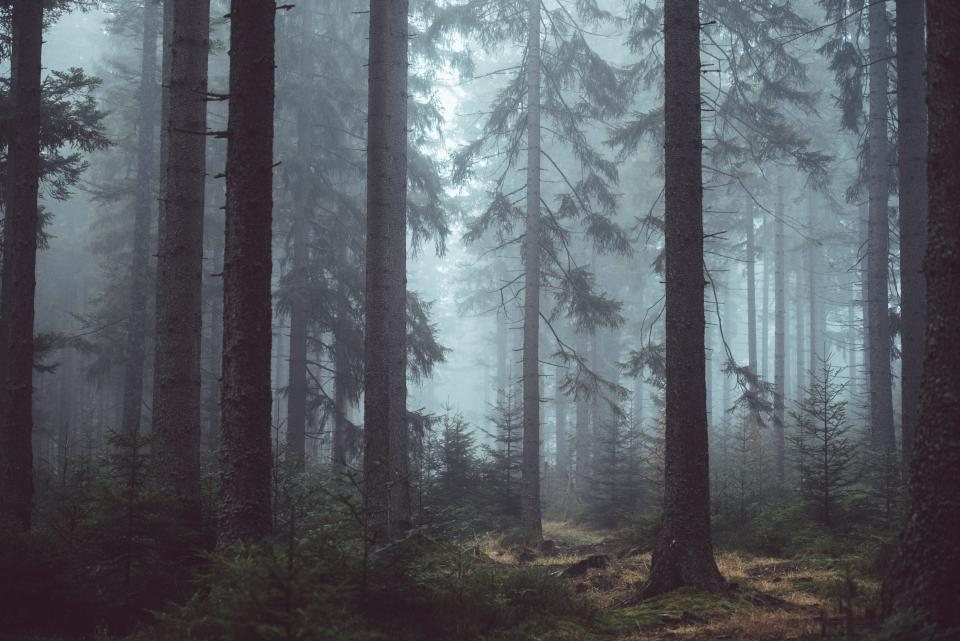
The forecast says rain, and most cameras stay in the bag. We have learned to do the opposite. Some of the pictures we care about most were made in weather that emptied the streets and the trailheads, when the light went strange and the world stopped looking like a postcard. Fog, rain and snow each change the light in a specific way, and once you know what each one does, bad weather stops being an obstacle and becomes a subject. This is a field guide to the three most useful kinds of bad weather and how to work in them without ruining your gear.
Fog: the great simplifier
Fog does three things to a scene at once. It removes the background, it lowers contrast with distance, and it turns every light source into a soft glow. The first is the most powerful. A messy woodland with tangled branches and a distant road becomes a few trees standing in white, because everything more than fifty metres away has vanished. Fog is the only weather that edits the world for you, and it makes minimalist pictures easy in places that are normally impossible to simplify.
The second effect, contrast falling with distance, is a depth cue that painters have exploited for centuries under the name aerial perspective. Objects near you are dark and sharp; objects further away are paler and softer; objects beyond that are barely there. A row of trees, posts or hills receding into fog is a lesson in layering handed to you for free. Compose so the layers overlap and the picture gains depth that would take real effort on a clear day.
The third effect suits early mornings and cities. Streetlights, car headlights and windows become haloed and soft, and the fog itself glows around them. Shooting toward a light source in fog gives you beams and rays as the light scatters through the moisture, especially in trees or between buildings. Backlit fog is one of the most beautiful lights there is.
The practical problems are exposure and focus. Fog is bright, and a camera left to itself will render it as grey. Add one to two stops of exposure to keep it white, and watch the histogram rather than the screen. Autofocus struggles because there are few edges; pick something with contrast near your subject or focus manually. And fog moves: it thickens, thins and lifts in minutes, so if the scene is good, keep shooting through the changes rather than waiting for a perfect moment that may not return.
Rain: reflections, saturation and the moment after
Rain has a bad reputation because rain itself is hard to photograph. The drops are small and fast and mostly invisible unless they are backlit. What rain does to the world, however, is very photographable. Wet surfaces reflect, so a street becomes a mirror of every light and sign above it. Colours saturate, because water fills the microscopic texture of stone, bark and pavement and lets them reflect colour rather than scatter white light. A dull red brick wall becomes deep and rich the moment it is wet.
The best rain pictures are often made at the edges of the rain: the minutes after it stops, when everything is wet but you can see clearly, and the light breaks through low cloud. This is when puddles are still and reflections are clean. In cities, work at dusk when the lights come on and the wet pavement doubles them. Look for umbrellas, which add colour and shape, and for people sheltering in doorways, which is a whole genre.
To show rain itself, you need a dark background and light coming from behind or beside the drops. A streetlight in a dark alley, low sun after a shower, a car’s headlights. A fast shutter freezes drops as specks; a slower shutter, around a thirtieth of a second, draws them as streaks, which reads more clearly as rain. Shooting through a rain-covered window from indoors is another approach: focus on the drops and let the world outside blur into colour.
Protecting equipment is simpler than it sounds. A lens hood keeps most drops off the front element. A cloth in the pocket, wiped often, handles the rest. Shoot from under an awning, from a car, or with a small umbrella in the other hand. Modern gear tolerates light rain well, but a wet front element ruins a picture faster than anything, so check it every few frames.
Falling snow
Falling snow behaves like rain but slower, which makes it easier to render. Large flakes against a dark background at a moderate shutter speed become soft white dots, and a wide aperture turns the nearest flakes into out-of-focus discs that give the picture a sense of being inside the weather. A long lens compresses the falling snow into a dense veil that isolates a subject from its surroundings.
Snow on the ground: high key and hidden colour
Snow on the ground changes the light in two ways. It bounces light upward, filling shadows so faces and objects are lit gently from below. And it pushes the whole scene toward high key, where most of the frame is light and the few dark elements become the subject. A dark figure, a fence line, a single tree or a red barn on a white field are pictures that draw themselves.
Snow is also the great revealer of colour temperature. Under overcast it is faintly blue; in the shadow of a hill under a clear sky it is strongly blue; at sunrise it is pink and gold. Automatic white balance will try to neutralise all of this. We set white balance by hand, often to daylight, and let the snow be whatever colour the sky made it. The blue shadows in snow are not a flaw; they are the picture.
As with fog, expose brighter than the meter suggests, usually by one to two stops, so the snow stays white without clipping. Keep spare batteries warm in an inside pocket. And when you come indoors, leave the camera in its bag for an hour to warm slowly, or condensation will form inside the lens.
Weather habits worth keeping
A few practices carry across all three conditions.
- Go out when it starts, not when it ends. Transitions, when weather arrives or clears, hold the most dramatic light.
- Expose for the brights, then check the histogram; fog and snow both fool a meter into underexposing.
- Look for the one dark or coloured element in a pale scene; it is almost always the subject.
- Carry a cloth, a hood and a plastic bag, and stop worrying.
Bad weather is only bad for the picture you were planning to take. It is very good for a different picture, one that most people will never make because they were waiting for the sun. The sun is fine. It is also crowded.